
Insert Headline
Insert text here.



Battle Prints

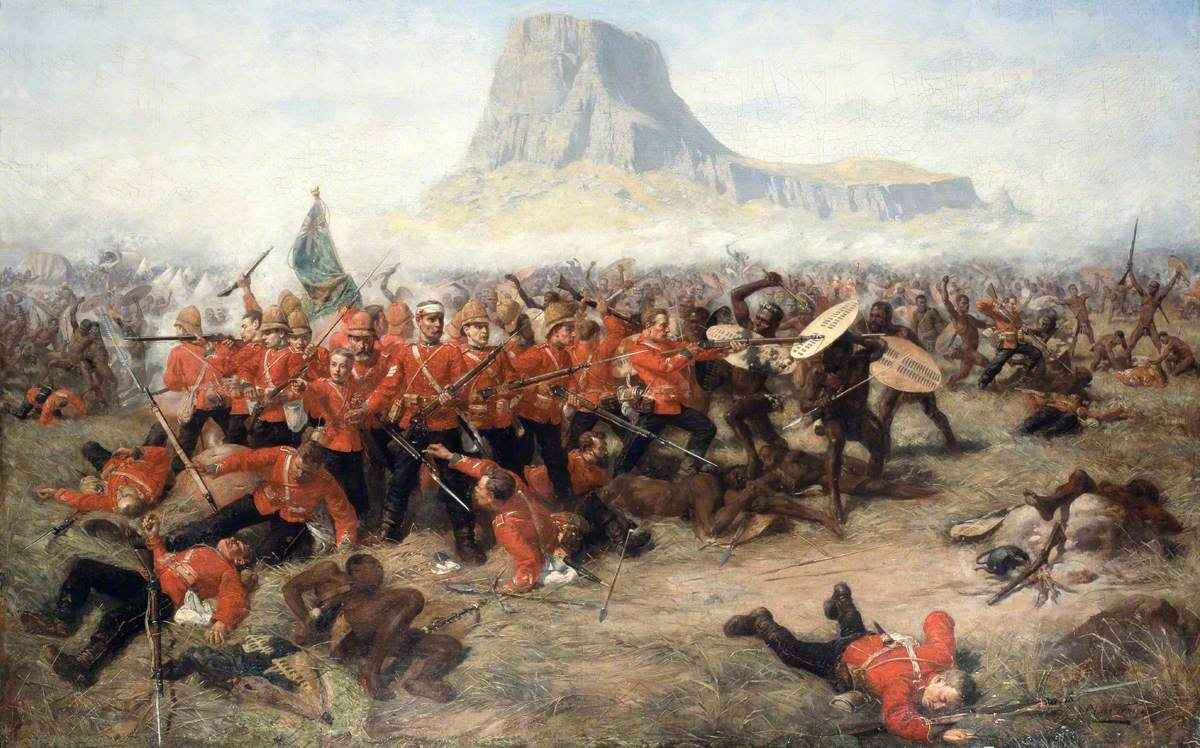
The Battle of Isandhlwana
22nd January 1879
Rorke's Drift, known as kwaJimu[10] ("Jim's Land") in the Zulu language, was a mission station of the Church of Sweden, and the former trading post of James Rorke, a merchant from the Eastern Cape of Irish descent. It was located near a drift, or ford, on the Buffalo (Mzinyathi) River, which at the time formed the border between the British colony of Natal and the Zulu Kingdom. On 9 January 1879, the British No. 3 (Centre) Column, under Lord Chelmsford, arrived and encamped at the drift.
On 11 January, the day after the British ultimatum to the Zulus expired, the column crossed the river and encamped on the Zulu bank. A small force consisting of B Company, 2nd Battalion, 24th (2nd Warwickshire) Regiment of Foot (2nd/24th) under Lieutenant Gonville Bromhead was detailed to garrison the post, which had been turned into a supply depot and hospital under the overall command of Brevet Major Henry Spalding, 104th Foot, a member of Chelmsford's staff.
On 20 January, after reconnaissance patrolling and building of a track for its wagons, Chelmsford's column marched to Isandlwana, approximately 10 km (6 mi) to the east, leaving behind the small garrison. A large company of the 2nd/3rd Natal Native Contingent (NNC) under Captain William Stevenson was ordered to remain at the post to strengthen the garrison.[11] This company numbered between 100 and 350 men.[12]
Captain Thomas Rainforth's G Company of the 1st/24th Foot was ordered to move up from its station at Helpmekaar, 16 kilometres (10 mi) to the southeast, after its own relief arrived, to further reinforce the position.[13] Later that evening a portion of the No. 2 Column under Brevet Colonel Anthony Durnford, late of the Royal Engineers, arrived at the drift and camped on the Zulu bank, where it remained through the next day.
British Army "Military Map of Zulu Land", 1879. Rorke's Drift is at the convergence of the red, green and blue border lines, Islandlwana is slightly to the right
Late on the evening of 21 January, Durnford was ordered to Isandlwana, as was a small detachment of No. 5 Field Company, Royal Engineers, commanded by Lieutenant John Chard, which had arrived on the 19th to repair the pontoons that bridged the Buffalo. Chard rode ahead of his detachment to Isandlwana on the morning of 22 January to clarify his orders, but was sent back to Rorke's Drift with only his wagon and its driver to construct defensive positions for the expected reinforcement company, passing Durnford's column en route in the opposite direction.
Some time around noon on 22 January, Major Spalding left the station for Helpmekaar to ascertain the whereabouts of Rainforth's G Company, which was now overdue. He left Chard in temporary command. Chard rode down to the drift itself where the engineers' camp was located. Soon thereafter, two survivors from Isandlwana – Lieutenant Gert Adendorff of the 1st/3rd NNC and a trooper from the Natal Carbineers – arrived bearing the news of the defeat and that a part of the Zulu impi was approaching the station.
Upon hearing this news, Chard, Bromhead, and another of the station's officers, Acting Assistant Commissary James Dalton (of the Commissariat and Transport Department), held a quick meeting to decide the best course of action – whether to attempt a retreat to Helpmekaar or to defend their current position. Dalton pointed out that a small column, travelling in open country and burdened with carts full of hospital patients, would be easily overtaken and defeated by a numerically superior Zulu force, and so it was soon agreed that the only acceptable course was to remain and fight.[14]
Defensive preparations
Once the British officers decided to stay, Chard and Bromhead directed their men to make preparations to defend the station. With the garrison's 400-odd men[15] working diligently a defensive perimeter was quickly constructed out of mealie bags, biscuit boxes and crates of tinned meat.[16] This perimeter incorporated the storehouse, the hospital, and a stout stone kraal. The buildings were fortified, with loopholes (firing holes) knocked through the external walls and the external doors barricaded with furniture.
At about 3:30 p.m., a mixed troop of about 100 Natal Native Horse (NNH) under Lieutenant Alfred Henderson arrived at the station after having retreated in good order from Isandlwana. They volunteered to picket the far side of the Oscarberg (Shiyane), the large hill that overlooked the station and from behind which the Zulus were expected to approach.[17]
Prince Dabulamanzi kaMpande
With the defences nearing completion and battle approaching, Chard had several hundred men available to him: Bromhead's B Company, Stevenson's large NNC company, Henderson's NNH troop, and various others (most of them hospital patients, but 'walking wounded') drawn from various British and colonial units. Adendorff also stayed, while the trooper who had ridden in with him galloped on to warn the garrison at Helpmekaar.[18]
The force was sufficient, in Chard's estimation, to fend off the Zulus. Chard posted the British soldiers around the perimeter, adding some of the more able patients, the 'casuals' and civilians, and those of the NNC who possessed firearms along the barricade. The rest of the NNC, armed only with spears, were posted outside the mealie bag and biscuit box barricade within the stone-walled cattle kraal.[18]
The approaching Zulu force was vastly larger; the uDloko, uThulwana, and inDlondo amabutho (regiments) of married men aged in their 30s and 40s and the inDlu-yengwe ibutho of young unmarried men mustered 3,000 to 4,000 warriors, none of them engaged during the battle at Isandlwana.[19] This Zulu force was the 'loins' or reserve of the army at Isandlwana and is often referred to as the Undi Corps. It was directed to swing wide of the British left flank and pass west and south of Isandlwana hill itself, in order to position itself across the line of communication and retreat of the British and their colonial allies in order to prevent their escape back into Natal by way of the Buffalo River ford leading to Rorke's Drift.
By the time the Undi Corps reached Rorke's Drift at 4:30 p.m., they had fast-marched some 30 kilometres (20 mi) from the morning encampment they had left at around 8 a.m., then to spend some 11.5 hours continuously storming the British fortifications at Rorkes Drift
with complements to Wikipedia
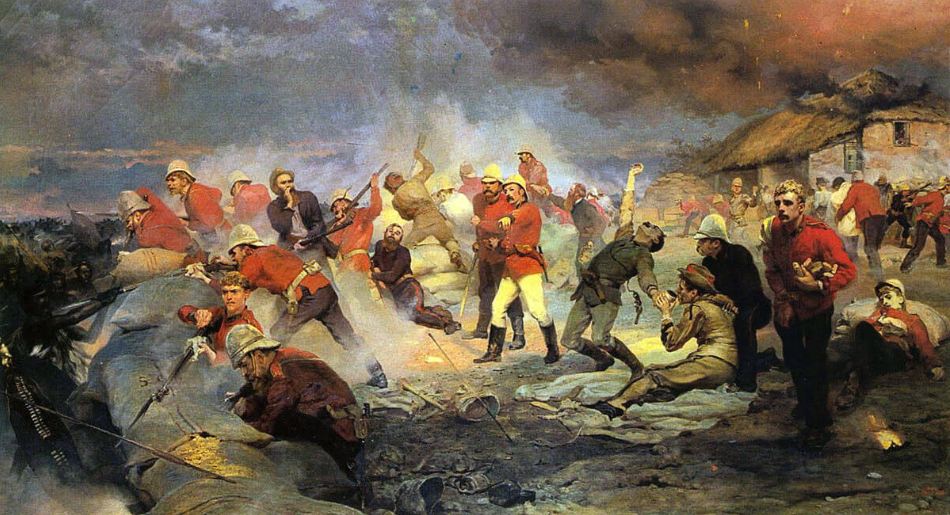
The Defence of Rorke's Drift
22nd to 23rd January 1879
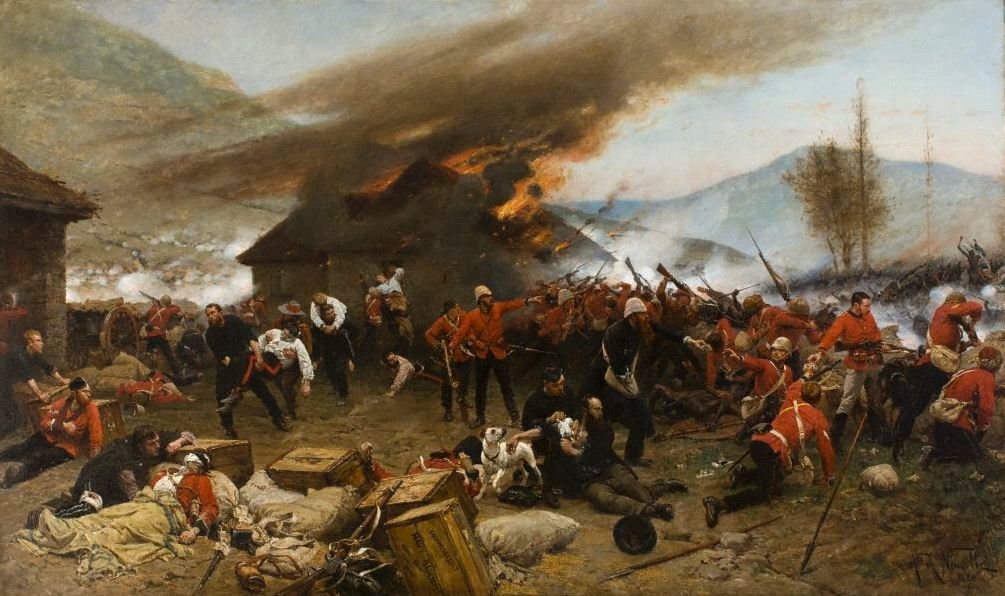
The Defence of Rorke's Drift
22nd to 23rd January 1879
The Battle of Isandlwana, January 22nd 1879
By Charles Edwin Fripp
The Defence of Rorkes Drift, January 22nd to 23rd 1879
By Elizabeth Thompson, Lady Butler
The Defence of Rorkes Drift, January 22nd to 23rd 1879
By Alphonse De Neuville
